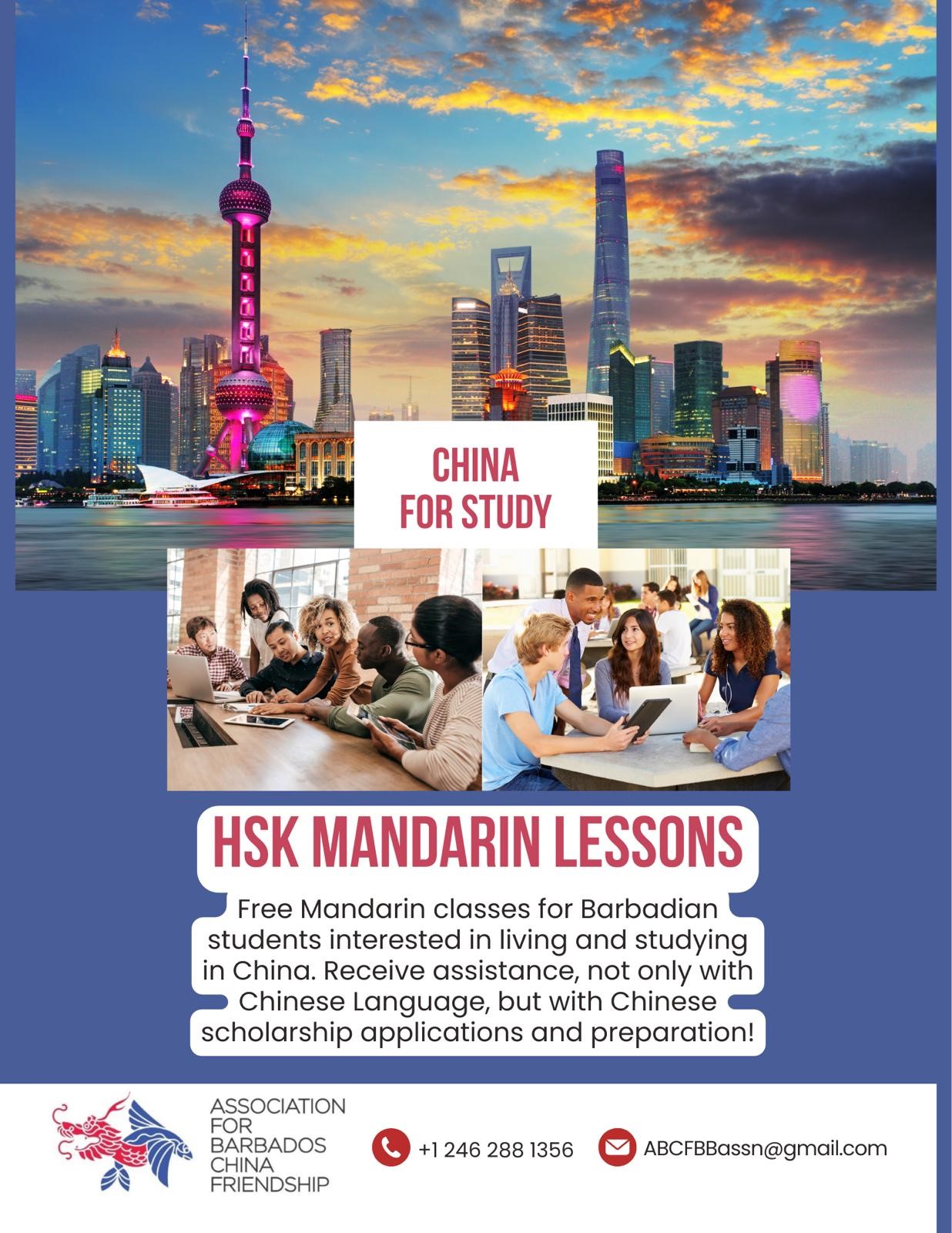
The application process for scholarships for university study in China for the academic year beginning in 2027 is now open, the Chinese embassy in Barbados has announced.
The scholarships cover tuition, accommodation, a monthly stipend and comprehensive medical insurance. Information about the scholarships, Chinese universities, and the range of programmes on offer may be found at this link, and the application requirements are on the website of the Chinese embassy in Barbados at this link.
The ABCF has a programme of free Mandarin tutorials to prepare you for study in China as well as a network of Barbadians living and studying in China who can advise on the application processes for scholarships, the choice of Chinese university, and preparation for life in China. In addition, the association’s network in China assists with the settling in process for new students. Please contact us by email or WhatsApp at the contacts shown above.
Beijing pledges hiring support in advanced manufacturing and modern services, plus retraining for workers at risk of AI displacement.
The number of Chinese university graduates is expected to hit a record 13 million next summer, adding pressure on a labour market already strained by slowing economic growth.
The 2027 cohort is estimated to be 2.4 per cent larger than this year’s projected 12.7 million graduates, according to the Ministry of Education on Thursday.
China has seen a steady rise in the number of university graduates over the past two decades, following a major expansion of enrolment that began in 1999. The annual number of graduates surpassed 10 million for the first time in 2022 and has continued to climb.
Is Beijing Stupid or Something? - by David Fishman
This is the second essay in a two-part series, and it’s the one I wanted to write in the first place. The first one, The Confidence Machine, which you can find it here, laid out a foundational argument about the historical role of the property sector in the Chinese macroeconomy. It would have been too bulky to include all of that in this piece.
In that first part, I described how Chinese households learned, over decades, that it was reasonable and rational to divert household income away from consumption and towards savings, primarily in the form of property accumulation. The property sector became the key organizing driver of household budgets, financial activities, and local government finances. It was a bubble, and everyone knew it, but it was also too big to be allowed to fail. Until Beijing allowed it to fail. Almost everything happening across the Chinese macroeconomy since 2021 is downstream of this decision.
Now the question is: what comes next? If Beijing deliberately dismantled this system that generated consumption confidence, growth, local government revenue, wealth appreciation, and a huge share of economic activity...then it surely had a plan for what was supposed to replace it, right?
Beijing DOES want the property market to stabilize of course - once it finds the price bottom. That’s where real consumptive demand for housing meets supply, and it should ideally be found organically. Policymakers want developers to finish homes people have already paid for, buyers to draw down the overhang of unsold housing, and then property prices to flatten out. But it is not interested in restoring property to its previous role as the great organizing engine of household wealth, local government finance and economic activity. Stabilizing property prices before underlying market fundamentals have been restored would be like removing a cast because the broken arm is mostly healed. They very much don’t want that.
Can China's Universities Keep Up With AI? - by Jiang Jiang
In this episode of Inside the China Room with Jiang Jiang, I’m joined by Professor Yang Wang, Vice-President of the University of Hong Kong and a mathematician whose academic career has taken him from China to the United States and back to Hong Kong. Wang spent more than three decades in the United States before returning to Asia. He previously held academic positions at Georgia Tech and Michigan State University and served in several leadership roles at the Hong Kong University of Science and Technology.
In our conversation, Wang explains why he believes universities must rethink their role in the AI era within the next year or two. He argues that AI could widen the gap between people with different levels of knowledge and analytical ability, and sees China’s emphasis on foundational education as an advantage. We also discuss the future of university degrees, the importance of critical thinking, and the roles of mathematics and the humanities in education.
Even Tencent Calls AI a “Life-or-Death” Fight
WeChat still dominates Chinese digital life, yet Tencent’s top executives have sounded a rare public alarm—telling the entire company to “start over” for the AI era.
…The proposed response is a sweeping redeployment of the organisation. They liken mature businesses to an army holding established ground and AI-native ventures to a navy setting out to sea. One half of the organisation should focus on upgrading and defending core operations, while the other half builds new AI businesses - likely the origin of the 50% job cut rumor. The company’s emphasis, however, is on moving people and resources to a different kind of competition, rather than simply adding AI features to existing products….
China Buffer: Asia-Pacific’s New Read on China
In this episode of Trending in China, hosts Yolanda and Diana record from Shenzhen as APEC brings global attention to the city. They move beyond the “China shock” framing and explore Chinese mainstream media’s “China buffer” idea—that China acts less as a shock and more as a shock absorber. Through energy, inflation, supply chains, climate tech and EVs, they discuss how China’s manufacturing and demand shifts can ease global price pressures, lower input costs for Asia-Pacific producers, and support green transitions and local jobs.
China's Social Security System Fails to Narrow Inequality, Chinese Scholars Argue
A paper in a CPC Central Party School journal calls for higher farmers’ pensions, lower pensions for civil servants and public-institution staff, and unified medical insurance.
For more than a year, Pekingnology and The East is Read have repeatedly covered calls to raise China’s meagre rural pensions and address inequalities in the country’s income distribution and social security system. Economists, retired officials, legislators, and commentators have increasingly joined the debate, arguing that China’s social security system needs to do more to narrow the gap between rich and poor, particularly between urban and rural residents.
Xi’s Message to Taiwan on Sun Yat-sen’s 160th Anniversary
The lead report in today’s paper is about the meeting to commemorate Sun Yat-sen’s 160th birth anniversary. Xi Jinping delivered a speech at the meeting. The immediate policy point that is of significance are his comments around Taiwan policy. The big takeaway is that he called for an approach of “peaceful reunification and one country, two systems” which functions “on the basis of upholding the one-China principle and the ‘1992 Consensus’” and opposition to “Taiwan independence”. Essentially, the approach is one of carrots and sticks to shape Taiwanese behaviour. Beyond this, as is par for the course in such meetings, Xi used the legacy of Sun Yat-sen to cast his policy priorities as a continuation of Sun’s vision for China—from patriotism, common prosperity to the concept of struggle and building a community of common destiny for mankind.
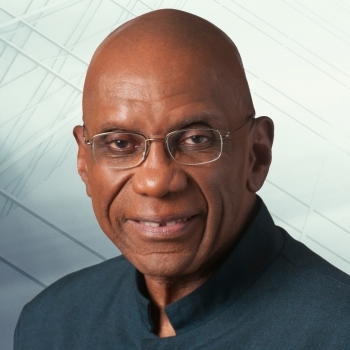
This weekly newsletter is put together by DeLisle Worrell, President of the ABCF. Visit us at Association for Barbados China Friendship | (abcf-bb.com).
I include news of the association and our members, as well as interesting items of news and a variety of commentary that you might not find elsewhere.
Thanks to everyone who sent contributions for this week’s Update. Please send items of interest to me via the contact page at ABCF-BB.com or to info@DeLisleWorrell.com
The ABCF mission is to build a deeper understanding between the Chinese people and Barbadians and Caribbean people from all walks of life. The association’s focus is on personal experiences, people-to-people contact, cultural exchanges and exchanges of ideas, and the facilitation of travel, business and study. From the outset we aim to learn from and build on the experiences of the Caribbean and China, and to develop mutual understandings and support that will be to the benefit of both sides.