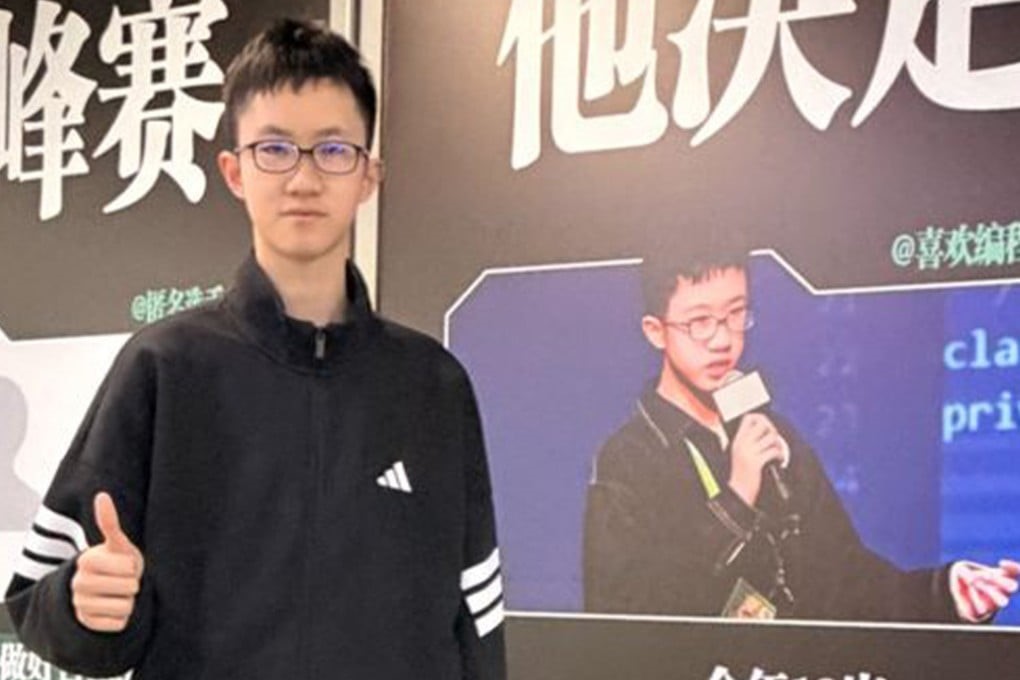
A 13-year-old boy from eastern China has garnered significant attention online for his ability to leverage artificial intelligence and programming to solve everyday challenges.
Yang Xizhe, a junior secondary school student from Hangzhou, Zhejiang province, stands at an impressive 1.9 metres tall and has amassed a following of over 500,000 on mainland social media platforms.
Growing up in a city celebrated for its vibrant technology ecosystem, he identifies as an “AI native.” Yang believes that for his generation, AI is becoming as vital as air and water.
In February last year, he gained recognition when a video demonstrating his use of AI to memorise English vocabulary attracted 20 million views.
He uploaded a photo of the vocabulary list to Doubao and created prompts to guide the chatbot in generating engaging stories and personalised exercises based on the words….
They Put Me on Stage in China… So I Gave the Whole Talk in Chinese
This time, I was invited to take part in a talk show at a foreign language school in Shenzhen as part of their first “class” of the year — although calling this thing a class might be underselling it a little. There were singers, plays, professional hosts, people doing backflips, kids dancing like robots… and an ACTUAL dancing robot. Then it was my turn. My talk was themed “I am a foreigner, but I am not an outsider” (我是外国人,但我不是外人) and was delivered completely in Chinese. I share some of the funny experiences I’ve had as a foreigner who speaks Chinese, a few of my encounters with Chinese culture, and eventually a more serious message about belonging, cultural exchange and becoming part of the community around you. And because most of the audience were kids, I got the chance to end with something a little more inspirational — which, to be fair, is much closer to my usual speaking style anyway So if you’ve heard enough of me speaking English on this channel, here’s 20 minutes of me putting my Chinese to the test instead. Don’t speak Chinese? Don’t worry — English subtitles are included!
Would Beijing Accept Taiwan on These Terms?
…On 29 August, Ci-Ze Li, an associate professor at National Changhua University of Education in Taiwan, published the first of three essays on the mainland WeChat blog Zhengdangshi (正当石), asking a question rarely discussed seriously in Taiwan: if cross-Strait unification were actually negotiated under “One Country, Two Systems”, what should Taiwan demand?
It is not clear who runs Zhengdangshi. The blog has become a platform for a series of exchanges on the concrete meaning of a “One Country, Two Systems” Taiwan solution, including contributions from both sides of the Strait. Given the political sensitivity of the subject and the unusually wide latitude of the discussion, it is difficult to regard this particular mainland setting as incidental. But there is no publicly available evidence establishing who is behind the account or what institutional connections, if any, it has.
…
At the mainland’s Taiwan Affairs Office’s 9 September press conference, a People’s Daily reporter specifically raised Li’s essays and the broader online discussion they had triggered.
The response welcomed the discussion but did not comment on Li’s specific proposals. Spokesperson Chen Binhua said Beijing welcomes more people in Taiwan beginning to understand and discuss the concrete content of a “Two Systems” Taiwan solution, adding that disagreement and debate in that process were normal.
Wu Jianmin: China’s Swift Response to 9/11 - by Zichen Wang
This week, the United States marked the 25th anniversary of the September 11 terrorist attacks through memorial ceremonies, readings of victims’ names, moments of silence, acts of service, exhibitions and other forms of remembrance across the country. Nearly 3,000 innocent people were murdered that day. A quarter-century later, the horror of the attacks deserves neither qualification nor abstraction: terrorism against civilians must be condemned, and the victims and their families remembered.
A few days ago, Julian Gewirtz deftly revisited another part of the history of those days: how China’s leadership reacted to the attacks, and how that response affected a U.S.-China relationship that had been under considerable strain in the months before 9/11. He recounts how Beijing quickly condemned the attacks and expressed sympathy to the United States, and how that response helped alter the atmosphere between the two countries. Toward the end of his note, Gewirtz cites the late senior Chinese diplomat Wu Jianmin, who described Jiang Zemin’s rapid outreach as “a very brilliant diplomatic move,” adding that sometimes “a phone call is more powerful than a million soldiers.”
Yan Xuetong: Leaders, Not Geopolitics or Institutions, Shape Gulf Security
For years, Yan Xuetong, one of China’s best-known international relations scholars, has advanced a striking argument: changes in world politics cannot be understood through structural forces alone. In his framework of “moral realism,” political leadership is a key variable. Material power and a country’s place in the international system set broad constraints, but leaders help determine how states act within them. The idea runs through his 2011 book Ancient Chinese Thought, Modern Chinese Power, his 2019 Leadership and the Rise of Great Powers, and the 2023 volume The Essence of Interstate Leadership: Debating Moral Realism. In a 2026 essay, Yan put the point particularly clearly: because a great power’s relative position is comparatively stable, political leadership is the theory’s “core independent variable.”
The essay below brings that argument directly into the present. Looking at the 2026 Iran war, Yan asks why conflict broke out when it did, given that geography, regime differences and the US-Israeli military advantage had existed for years. His answer focuses on what changed: the choices of political leaders, above all Donald Trump and Benjamin Netanyahu.
New Open-Access Book: China and the Next Global Order
The Center for China and Globalization (CCG) Update is pleased to share the publication of China and the Next Global Order: Coming Multipolar World and Great-Power Coopetition, the latest book by Henry Huiyao Wang, Founder and President of CCG.
Published by Springer Nature, the volume forms part of the China and Globalization book series. It is available open access and can be read and downloaded free of charge.
"China Shock" or "China Buffer"? - by PekingEnsight
There is no question that China’s economic scale, industrial rise and expanding global presence are reshaping the dynamics of the world economy. A transformation of such magnitude will inevitably bring adjustment, competition and pressure to certain sectors and economies. That is precisely why narratives such as the “China Shock” and “China Squeeze” are so easy to sell: they offer a simple and intuitive way to describe the change.
But as many economists have argued and as growing evidence has shown, focusing solely on who faces greater competition risks overlooking the broader ways in which China is reshaping the global economy.
In times of crisis, Chinese demand, production capacity and supply chains have helped absorb external shocks. For developing economies, China’s market, equipment, technology and investment have expanded, rather than narrowed, the space for industrialization. And as Chinese companies go global, their presence is increasingly taking the form of local production, employment, technology transfer and participation in the green transition.
Three recent stories released by China’s Xinhua News Agency explore this often-overlooked side of the picture, examining where China acts as a buffer, expands opportunities and helps other economies build capacity, rather than a source of shock.
The first introduces the idea of a “China Buffer” -- China’s role in cushioning the global economy against disruptions, from energy shocks and supply-chain stress to inflation and climate challenges.
The second extends that idea to the Global South, arguing that China’s market, equipment, technology and investment are not competing for a fixed share of global production, but can help enlarge the economic pie and provide a “ladder” for industrial upgrading.
The third puts that argument to the test in one of China’s most globally visible industries: new energy vehicles. From Spain and South Africa to Brazil and Malaysia, it looks at how Chinese automakers are increasingly creating local jobs, building supply chains and supporting the green transition.
China Connections – Breaking Into U.S.-China Policy Work – US-China Education Trust
The U.S.-China Education Trust (USCET), in partnership with the Sigur Center for Asian Studies, the Elliott School Graduate Student Services, Young China Watchers, and Career China Newsletter invites you to “China Connections: Breaking Into U.S.-China Policy Work,” on Wednesday, October 14, from 6:00 – 7:15 PM at the Lindner Family Commons, 1957 E St NW, Room 602, Washington, D.C.
Those studying China today face growing uncertainty regarding potential career pathways in the U.S.-China field, even as China expertise is more needed than ever across both the public and private sectors to navigate global challenges. This event brings together early-to mid-career professionals working on U.S.-China relations across the consulting, corporate, think tank, NGO, and government sectors to share insights from their career paths, highlight career possibilities, and offer practical advice for those considering work in foreign policy.
The evening will open with a keynote from Robert Daly, followed by a panel discussion featuring Kalisha Holmes, McCall Mintzer, Bernice Xu and Neil Thomas, moderated by USCET Managing Director Ryan McElveen, and close with a light reception and networking session.
This event is open to the public, with a particular focus on those exploring careers connected to foreign policy and China.
Cui Fan: China Certainly Will Not Apologise for “Overcapacity”
….On 30 June, the German magazine Internationale Politik und Gesellschaft (IPG) published an interview with German sinologist Marina Rudyak, who said: “The fundamental mistake we have made in dealing with China…was not to believe them. Or perhaps, at an even more fundamental level, we never seriously engaged with what they had actually said and written.” …
The position paper issued by China’s Ministry of Commerce….demonstrates China’s unwavering determination to build a modern industrial system through openness and cooperation, and expresses China’s sincere willingness to work with countries around the world to foster an open and inclusive framework for cooperation across industrial and supply chains.
The United Nations can count on China’s support, the UN’s peacekeeping chief said in Beijing as he flagged the body’s financial strains – due in large part to Washington’s funding squeeze.
Speaking at the Xiangshan Forum in Beijing on Wednesday, UN undersecretary general for peace operations Jean-Pierre Lacroix said the international system was under severe strain and the UN urgently needed to adapt its tools to modern realities.
Lacroix warned that the global body’s financial situation “is concerning member states” and it cannot be expected to deliver the same results with “steadily fewer resources, reduced mobility and a shrinking field presence”.
With the 11-nation Brics grouping pledging to boost cross-border payment links but making no move towards establishing a common currency, analysts said the vow marked a shift towards a more pragmatic de-dollarisation strategy rather than a retreat from the effort.
A 45-page leaders’ declaration issued on Saturday at the Brics summit in New Delhi said the group’s Payment Task Force would continue working to facilitate “fast, low-cost, more accessible, efficient, transparent and safe” cross-border payments among Brics countries.
However, Sudhakar Dalela, secretary of India’s Ministry of External Affairs, told a news briefing on Saturday there was “no proposal in the Brics for a Brics currency, as of now”.
Chinese scientists say they have devised a new technique for refining oil that cuts the amount of energy consumed during the process by roughly 90 per cent.
If the technology used in the study could be scaled up for industry, it would not only greatly reduce production costs and emissions, but also make the process more precise and boost product value.
The gaffe at last month’s Aids 2026 conference in Rio de Janeiro, where a US State Department presentation displayed a map of Africa with every country mislabelled, serves as more than a source of embarrassment. It was a potent symbol of the distance between Washington’s rhetoric and its real stance regarding the African continent.
Earlier this year, Nick Checker, a senior US State Department official, spoke of “resetting” US relations with Africa, pivoting away from dependency and towards mutually beneficial partnerships. Yet, as the mislabelled map suggests, the actual engagement often feels disconnected, chaotic and transactional.
Washington’s policies towards Africa have long been a study in contradiction. While American officials try to put the focus on what they call China’s debt traps, the US often pursues a policy defined by punitive tariffs, restrictive visa policies and selective interventions.
24 Hours in My Life: The Reality of Living in China that No One Talks About
Spend a full day with me in Shenzhen and see what everyday life in China really feels like — from local food and daily convenience to robotaxis, city nights and more. A lot of this feels completely normal to me, but I know it may look very different from the outside.
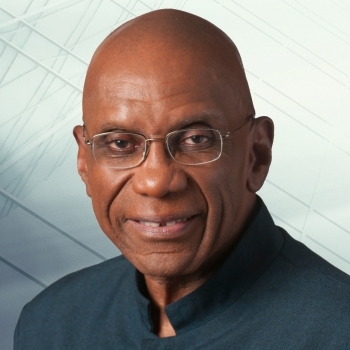
This weekly newsletter is put together by DeLisle Worrell, President of the ABCF. Visit us at Association for Barbados China Friendship | (abcf-bb.com).
I include news of the association and our members, as well as interesting items of news and a variety of commentary that you might not find elsewhere.
Thanks to everyone who sent contributions for this week’s Update. Please send items of interest to me via the contact page at ABCF-BB.com or to info@DeLisleWorrell.com
The ABCF mission is to build a deeper understanding between the Chinese people and Barbadians and Caribbean people from all walks of life. The association’s focus is on personal experiences, people-to-people contact, cultural exchanges and exchanges of ideas, and the facilitation of travel, business and study. From the outset we aim to learn from and build on the experiences of the Caribbean and China, and to develop mutual understandings and support that will be to the benefit of both sides.