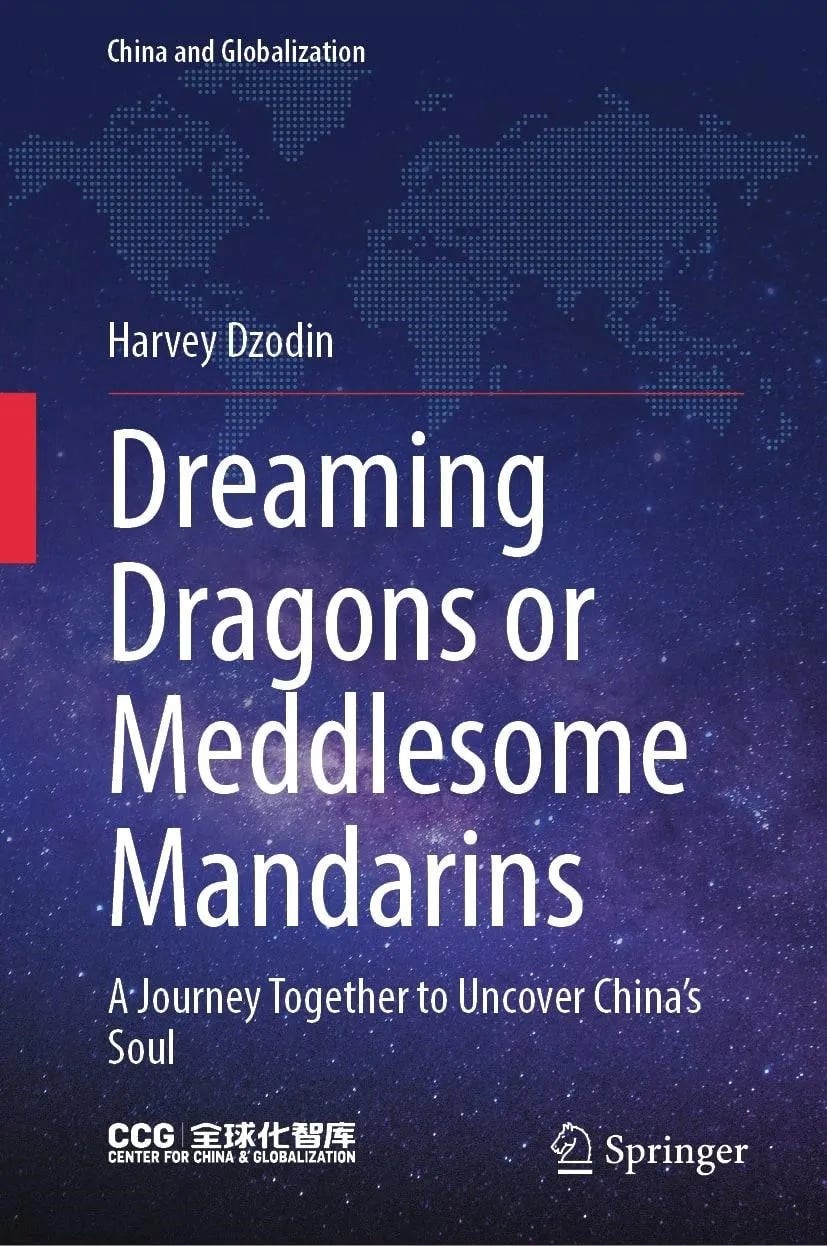
Transcript: Book Launch of "Dreaming Dragons or Meddlesome Mandarins"
In Part One of the book, “What’s Past Is Prologue”, we go on a journey to uncover China’s essence and how its past presages its rich present and future. We begin by briefly exploring some of China’s 83 dynasties and 559 emperors over a remarkable 4,000-year period that spawned unparalleled economic success and national wealth, something completely unknown to most Westerners. We explore competing visions for a new China and the traumas and experiments of the twentieth century that set the stage for reform and opening up, and later the evolution of China’s leadership from Mao to Deng to Jiang, Hu, and Xi.
In Part Two, “New China, Take Two”, we focus on China’s opening up and engagement with the world through economics, charting China’s return to the world stage, to the UN, Sino-U.S. normalisation, WTO accession, and the pursuit of moderate prosperity as China became the world’s factory. The book unpacks ideologies—communism, Marxism, socialism—and their adaptations by various Chinese leaders, and contrasts ideals with pragmatic governance, even using the Israeli kibbutz as a real-world case of why pure Marxian communism is a chimaera.
Part Three, “The China Experiment”, reflects my view of how SOEs and later hybridised planning-market mechanisms actually function. We discuss national champions like Huawei. I explain my view of how the party-state works in practice, with the whole-process people’s democracy that we have seen in action over the last couple of weeks. We also discuss how surprisingly well it delivers results thanks to its management tool of five-year plans and a system that rewards achievements rather than blah, blah, blah….
I turn to global crises that I care deeply about in Part Four, “Perceptions and Reality”. There, I discuss globalisation, climate, and environmental stress, China’s leadership in renewables and electric vehicles, and the demographic burdens and opportunities created by past population policies. I devote a chapter to perceptions and misconceptions of China, and to the mixed record of China’s soft-power efforts via Confucius Institutes, foreign-language state media, some representatives of which are here today, and cultural diplomacy. I also try to explain why think tanks, exemplified by CCG, are important transnational vehicles for diplomacy and policy dialogue that, in fact, are at times even more effective….
But I can tell you the book’s bottom line: that all countries are a changing mixture of good, bad, and ugly at any given point in time, but China has uniquely lifted more people out of extreme poverty than any other country, and continues to serve its people well. In fact, Chinese people, in international surveys after survey, rate the performance of their own government, led by the Communist Party of China, more highly than others rate their own governments’ performance.
…The only way to know China is to see it in person, now that it has never been easier to do. My goal is to whet readers’ appetites to do so and to make their own judgments with their own eyes.
Zhejiang China Commodities City Group, operator of the marketplace that was once the epicentre of global consumer goods trading, is planning an initial public offering (IPO) in Hong Kong to support overseas expansion, as the wave of mainland Chinese firms looking to raise funds in the city continues.
The state-owned company, which runs the Yiwu international trade market in east China’s Zhejiang province, said in a filing to the Shanghai Stock Exchange on Wednesday that a share sale in Hong Kong would mark a milestone for its global ambitions as it lured more overseas talent to strengthen core competence.
The Hong Kong listing plan was announced after the company reported a net profit of 4.2 billion yuan (US$614.4 million) for 2025, up 36.8 per cent from a year earlier. Revenue jumped 26.6 per cent to 19.9 billion yuan.
Beijing Is Not Rushing Reunification - by Zichen Wang
The real news from Xi’s meeting with Cheng Li-wun is the mainland's signal on peace, patience, and step-by-step progress.
Full Transcript of Xi Jinping and Cheng Li-wun's Remarks and Cheng's Press Conference
In the first such meeting in a decade, Xi Jinping and Kuomintang chair Cheng Li-wun cast dialogue and peaceful development as the only viable path forward.
In classrooms and training centres across China, a growing number of students from Southeast Asia, Africa and beyond are learning not just the Chinese language, but how the country’s factories operate, how supply chains are managed and how products are marketed and sold across borders.
Hebei Software Institute, in the northern city of Baoding, has been at the forefront of the push. The vocational college said it had established multiple overseas-oriented programmes in recent years, particularly with partners in Thailand, combining Chinese-language training with courses in e-commerce, digital marketing and information technology.
As economic growth slows at home and Chinese companies push deeper into global markets, vocational education is emerging as a quiet yet strategic tool – not just training workers but also supporting the export of industrial ecosystems, standards and ways of doing business.
2 years on: China’s ‘desert wheat farms’ show the seeds of success | South China Morning Post
China’s “desert wheat farms” have survived repeated sandstorms and continue to grow following an initial trial in the country’s largest desert, as part of an ongoing effort to combat desertification and unlock the land’s potential for strengthening national food security.
Two years ago, on the fringes of the Taklamakan Desert in the Xinjiang Uygur autonomous region, China launched an unprecedented project to plant wheat in sand.
The first harvest, covering 400 hectares (988 acres) on the desert’s southwestern edge, proved a landmark achievement. Since then, sustained efforts across various desert locations have enabled crops to withstand harsh conditions, while reducing the labour required as the planting area expands.
Hongkongers crossed the border into Shenzhen in droves on the second day of the Easter holiday on Saturday, drawn by a wider range of bargain-priced shopping, dining and entertainment options, as well as new landmark attractions including a futuristic tech museum.
China has broken ground on a 50-megawatt concentrated solar power plant in Tibet at an altitude of 4,550 metres (14,900 feet), making it the world’s highest-altitude parabolic trough solar thermal facility.
The project, located in Dangxiong County, incorporates a 400-megawatt photovoltaic system and is scheduled for full operation by 2027, Xinhua reported. Preparatory digging at the site began on Monday.
Once dubbed the world’s tallest abandoned skyscraper, Goldin Finance 117 in northern China appears to be in the homestretch of a marathon construction effort – after nearly a decade of dormancy and a year of resumed work – even as the nation’s property market struggles to leg out a sustained recovery.
Late last month, workers began installing a diamond-shaped crown on top of the building – designed to be 596 metres (1,955 feet) tall upon completion – in the port city of Tianjin, according to state media reports.
Eighteen years after construction began, the saga of this closely watched building has long underscored both the collapse of China’s property market and the nation’s retreat from earlier pursuits of supertall skyscrapers.
China’s electric truck revolution: powerful painkiller for the Iran war? | South China Morning Post
For marketing manager Wang Yuan, who sells electric heavy-duty cargo trucks in the rugged landscapes of Xinjiang in western China, business is riding a new and powerful wave.
The commercial vehicle company he works for is a major player in the domestic market. The lion’s share of its electric heavy trucks are destined for coal-rich provinces including Shanxi and Inner Mongolia, apart from Xinjiang itself.
In Xinjiang alone, according to Wang, sales across all brands reached around 16,700 units in 2025 – a staggering 80 per cent surge from just over 9,000 in 2024.
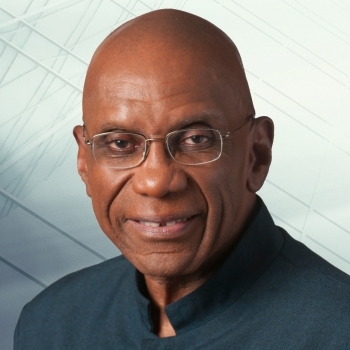
This weekly newsletter is put together by DeLisle Worrell, President of the ABCF. Visit us at Association for Barbados China Friendship | (abcf-bb.com).
Thanks to everyone who sent contributions for this week’s Update. Please send items of interest to me via the contact page at ABCF-BB.com or to info@DeLisleWorrell.com
The ABCF mission is to build a deeper understanding between the Chinese people and Barbadians and Caribbean people from all walks of life. The association’s focus is on personal experiences, people-to-people contact, cultural exchanges and exchanges of ideas, and the facilitation of travel, business and study. From the outset we aim to learn from and build on the experiences of the Caribbean and China, and to develop mutual understandings and support that will be to the benefit of both sides.