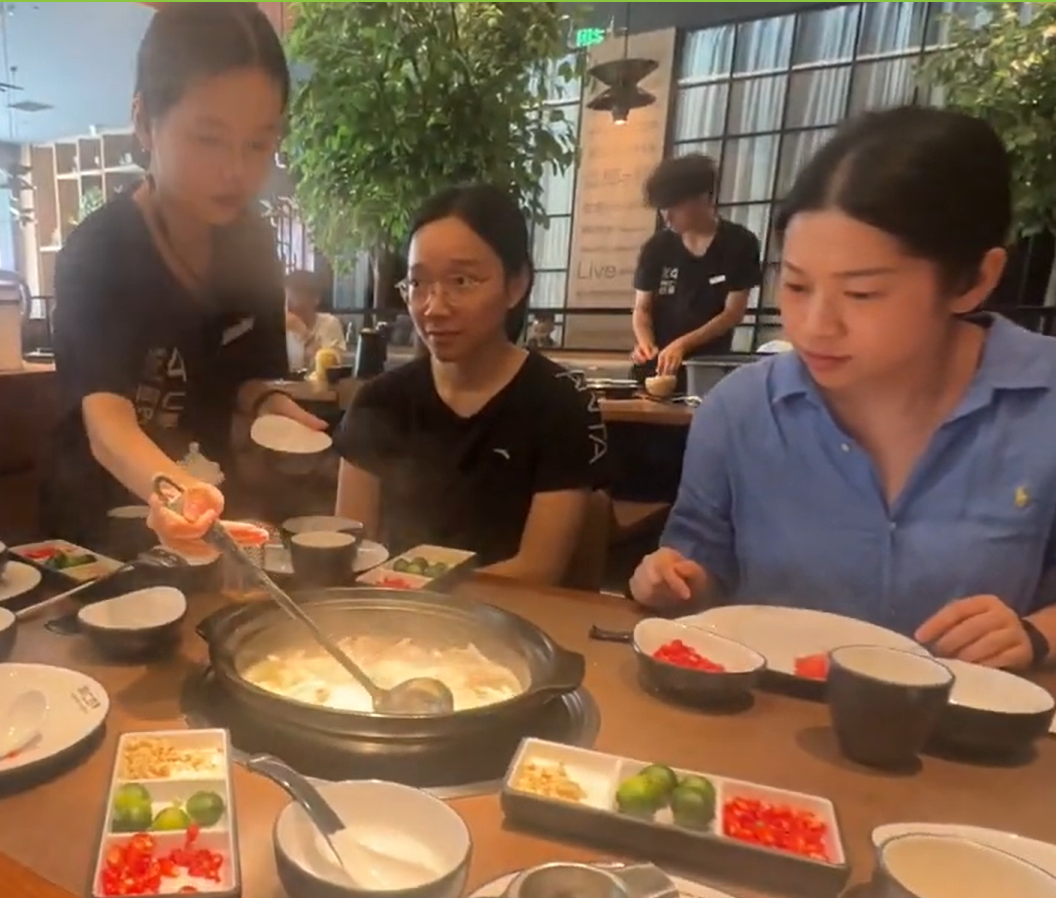
What Eating Out in China Is Really Like
Joshua writes:
I went out for coconut chicken hotpot with some new Chinese friends, and figured I’d bring you guys along for a pretty normal night out here. Good food, good conversation and a little look at everyday life in China. Come eat with us.
China’s “New New Trio” Is Moving Beyond Containers
…Robotics is one of several Chinese technology stories drawing attention this summer.
A month earlier, Beijing-based Moonshot AI released Kimi K3, a 2.8-trillion-parameter open-weight model with a one-million-token context window. Its release drew attention well beyond China, adding to a broader debate over the growing presence of Chinese models in the global open-weight AI ecosystem….
A similar shift is visible in China’s biotech sector. Overseas licensing deals involving Chinese innovative drugs exceeded 100 billion U.S. dollars in total potential value in the first half of 2026, setting a new record, according to China’s Ministry of Industry and Information Technology (MIIT)….
These three sectors — robotics, artificial intelligence and innovative drugs — have recently been grouped together in China under a new label: the “New New Trio”.
Zhu Rongji’s Four Phrases for the State-run Press
Former Chinese premier Zhu Rongji died of illness at the age of 98 in Beijing on August 12, 2026. His body was cremated on August 18, when the Chinese flag at Tiananmen Square flew at half-mast in memory of him.
Zhu was a member of the Standing Committee of the Political Bureau of the 14th and 15th Central Committees of the Communist Party of China (CPC). He was vice premier from 1991 to 1998 and premier from 1998 to 2003 of the State Council, China’s government cabinet.
China’s unsolicited consultants - by Zichen Wang
A problem has arisen at Starbucks in China. Some people sit in its cafés for hours without buying anything, sometimes bringing their own food and drinks. Paying customers complain that they cannot find a seat.
A perfectly legitimate subject for journalism. Jiemian News 界面新闻, a Shanghai-based financial-news outlet, duly made it one. But it went further. After considering Starbucks’s competition, average spending per customer and its “third place”—the idea that its cafés should be welcoming spaces outside home and work where people can linger—the article arrived at a prescription: paying customers should come first; those occupying tables without buying anything should, in effect, buy something or leave.
Chinese people don't know "breakneck" - by Robert Wu
…In the sharing session, I mentioned the book Breakneck by Dan Wang, which went viral last year in overseas China-watching circles. Even many people who are not normally interested in China have read that book.
I wanted to use this book to make a point: when international audiences look at China, it’s not really China they are looking at; it is themselves.
Just like Breakneck, which is supposed to be the most popular book about China in recent years, the book is actually less about China and more about how the U.S. compares with China, and it’s the anxiety that Americans feel about deindustrialization that ultimately fuels the popularity of the book.
David Daokui Li On The End of Offshore Tax Evasion for China’s Wealthy
On 24 July 2026, China’s Ministry of Finance and State Taxation Administration jointly issued new rules on the individual income taxation of offshore trusts. In plain English, the rules impose tax at key stages in the life of an offshore trust — including asset transfers, income generated within the trust, and distributions or termination — making it considerably harder for Chinese tax residents to use offshore structures to defer or avoid tax.
The move has quickly made international financial headlines, from the Wall Street Journal and the Financial Times to Bloomberg and CNBC. Most of the coverage has fairly noted both the long-standing use of offshore trusts by wealthy Chinese to reduce or defer their tax liabilities and Beijing’s growing incentive, amid mounting fiscal pressures, to raise revenue.
It Takes Four Generations: Demographic Replacement and the Statistical Legacy of China's Development
…These questions illustrate one of the more obvious consequences of what Chinese demographic researchers call the “compressed demographic transition” 压缩式人口转变.7 Over the last seventy years, China’s economy and society have changed so much, and so rapidly, that constituent cohorts of its population grew up in functionally different countries. Accordingly, they reflect welfare outcomes from very different stages of development. For national aggregate statistics, these cohorts are averaged together. This yields averaged indicators that are statistically accurate, but often fail to describe the conditions experienced by any single generation particularly well.
Educational attainment illustrates the mechanism clearly because it is straightforward to assess in population surveys. But the same logic applies to indicators as diverse as height, civic behavior, or wealth. Just as you usually cannot go back to attend primary school in your retirement, a retired person cannot benefit from accumulated wealth they never had the opportunity to earn, nor can they draw pension income from decades of contributions they never had the opportunity to make. Experiences in early life cast a long shadow.
Tom Hancock at Bloomberg last year wrote a very good piece How China’s communist officials became venture capitalists (via the Times of India, so it’s free):
Hefei has pioneered a shift in Chinese capitalism over recent years in which local governments are increasingly taking minority stakes in private companies. Since the 1950s, Hefei has been a hub of scientific research, but today its shrewd investments have transformed it from a relative backwater to a bustling metropolis of about 5 million people. In terms of economic growth, what Chinese media call the “Hefei model” appears to work. In the decade to 2020, Hefei was China’s fastest-growing city in terms of gross domestic product.
A study analysing data from hundreds of countries and regions suggests China’s Belt and Road Initiative is linked to better governance and economic development, according to researchers from Nanjing University.
They found the trade and investment scheme – which spans Africa, Asia, Europe and beyond – was also associated with improved corruption control and that it reduced debt risks.
The team – from the university’s Centre for Asia-Pacific Development Studies and led by Mao Weizhun – said their findings challenged characterisations of the trade and infrastructure initiative as a “failure”, “vulnerability trap”, “road of corruption” or a “debt trap”.
Opinion | A strong China is the best hope for the ‘long peace’ to endure | South China Morning Post
…The real long peace is China’s peaceful rise that began in 1978, when Beijing started its “reform and opening up” period. Peace lasting half a century has been a rarity throughout Chinese history. Chinese dynasties are punctuated with discontented peasant groups forcibly toppling reigning dynasties, only for subsequent peasant uprisings to overthrow the regime in a repeating cycle. Even in the early decades after the founding of the People’s Republic of China, military conflicts still occurred roughly once every decade, including the Korean war, the Sino-Indian war and the Sino-Vietnamese war…
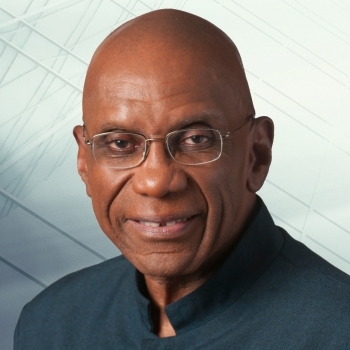
This weekly newsletter is put together by DeLisle Worrell, President of the ABCF. Visit us at Association for Barbados China Friendship | (abcf-bb.com).
Thanks to everyone who sent contributions for this week’s Update. Please send items of interest to me via the contact page at ABCF-BB.com or to info@DeLisleWorrell.com
The ABCF mission is to build a deeper understanding between the Chinese people and Barbadians and Caribbean people from all walks of life. The association’s focus is on personal experiences, people-to-people contact, cultural exchanges and exchanges of ideas, and the facilitation of travel, business and study. From the outset we aim to learn from and build on the experiences of the Caribbean and China, and to develop mutual understandings and support that will be to the benefit of both sides.