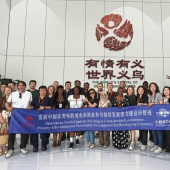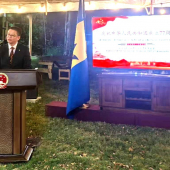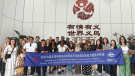
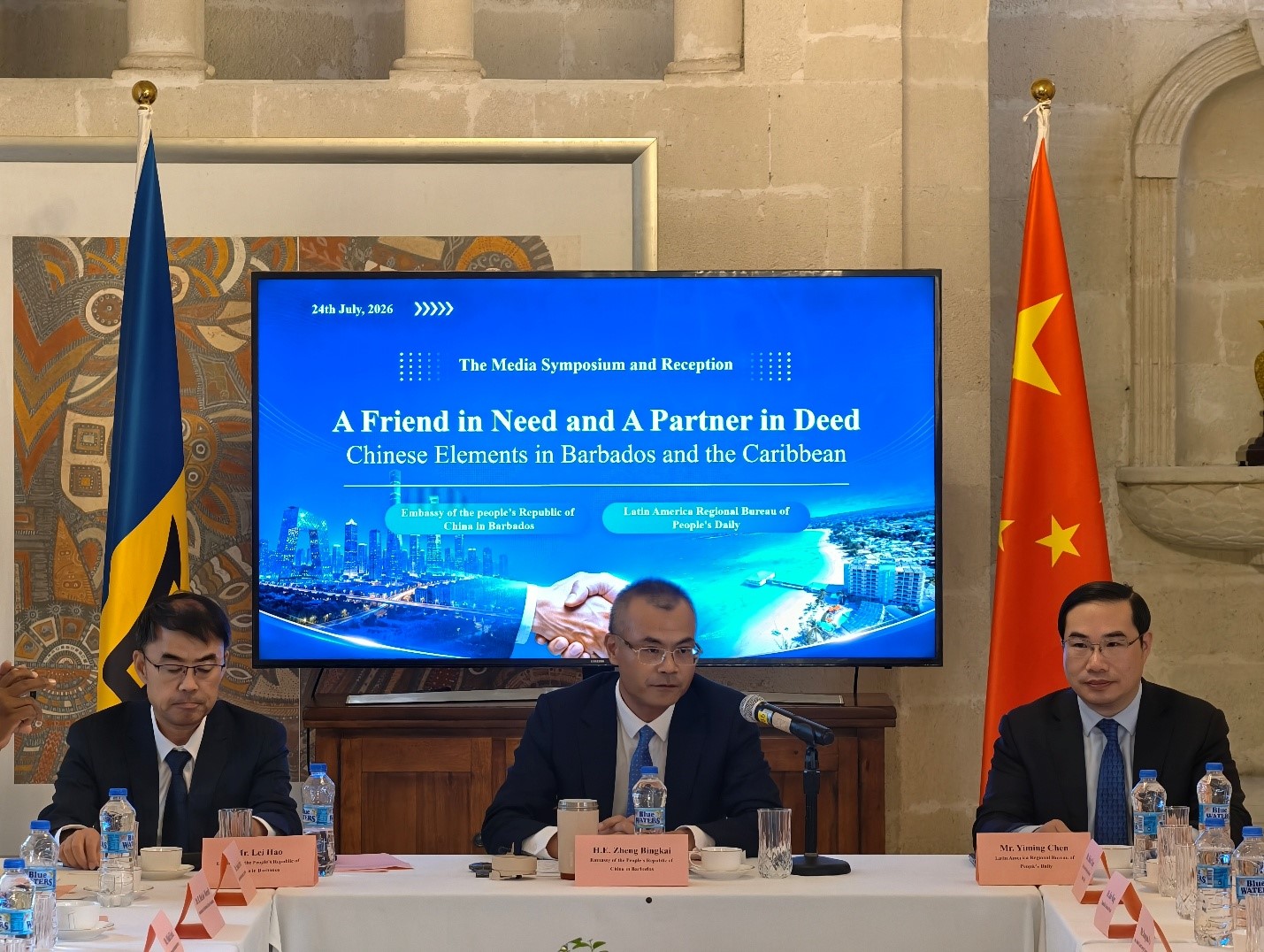
On Friday July 24 Chinese ambassador to Barbados ZHENG Bingkai hosted a media symposium on the topic “A friend in need, a partner indeed: Chinese elements in Barbados and the Caribbean”. The occasion was the visit to Barbados of Mr CHEN Yiming, Director General for Latin America and the Caribbean of the Chinese People's Daily newspaper, who is posted to Brazil. The seminar was attended by local and regional media.
Presentations were made by the managers of Chinese cooperation projects in Barbados, including the rice cultivation project, the sewage plant project, and the work of the Chinese medical team. Mr Sanka Price welcomed his visiting colleagues on behalf of the Caribbean Broadcasting Corporation, Dr Che Corbin, Co-director, spoke of the courses offered by the Confucius Institute, and I mentioned the ABCF’s free Mandarin tutorials, the joint youth forum with the Zhejiang International Studies University, and the other information available on our website.
Ambassador Zheng began his remarks by offering condolences to the Barbadian public on the passing of Sir Gary. He spoke of the importance of the visit of his distinguished guests as evidence of the People's Daily’s strong commitment to the Caribbean region. He said:
China and Barbados both support a more just and equitable international order. We believe that all countries, regardless of size, should have an equal voice in global affairs. We are committed to promoting inclusive, sustainable development. In particular, both our countries attach great importance to strengthening climate resilience and ensuring that the voices of developing countries and the Global South are better represented in international governance.
China Is Not Pulling Up the Ladder - by David Fishman
…My disagreement lies elsewhere: not with the idea that China is a formidable competitor, but with the claim that this amounts to “pulling up the ladder” according to some general theory of how development works. It relies on assumptions that do not hold up to closer scrutiny and treats the interests of a relatively small number of manufacturing competitors as though they were synonymous with the interests of the entire developing world. Ultimately, this thesis relies less on any real-world model of industrialization, and more on a tidy moral narrative of victims and oppressors. Once the actual mechanics of development are examined, and once we ask who really benefits from the proposed remedies, the argument is just not very convincing….
Joseph Chang Yanfeng was ordained bishop of Chifeng in China’s northern Inner Mongolia autonomous region on Wednesday, highlighting the uneasy diplomatic engagement between Beijing and the Vatican on the sensitive issue of Catholic appointments.
According to Vatican News, Pope Leo XIV approved Chang’s appointment on June 15, under the terms of a 2018 provisional agreement between the Holy See and Beijing.
The ordination fills a vacancy for the Catholic diocese of Chifeng that had lasted nearly two decades, following the 2006 death of Andreas Zhu Wenyu, according to AsiaNews, a Catholic missionary news agency based in Italy….
Zichen Wang: Beijing’s message to the world’s tourists — come here and judge China for yourselves
By relaxing visa rules, Beijing has two things on its mind – boosting its economy and improving its self-image
Walk through central Beijing today and one thing quickly becomes apparent: foreigners are back. They are taking photos outside the Forbidden City and sitting in cafes around Gulou and Sanlitun. The shift is visible online, too; YouTube is increasingly filled with videos titled “China Shocked Me” or “My First Week in China”. Most of the creators are tourists, not China specialists or journalists, and many of them are encountering the country for the first time.
The resurgence is striking because to many outside observers China’s story has become one of closure and increased security – of intensifying strategic rivalry with the west, expanded anti-espionage enforcement and increasingly constrained foreign reporting, including the withholding and revocation of visas for US journalists. Yet on the ground, another story is unfolding. When it comes to its relationship with the rest of the world, Beijing increasingly appears to be betting on direct exposure: come to China and judge for yourself.
Inside a Candid Debate on China's Grassroots Government
Recently, Banyuetan (半月谈), a Xinhua-affiliated magazine published every two weeks, devoted an entire discussion to that seemingly simple question:
基层单位,有没有必要搞公众号?
Is it really necessary for grassroots governments to operate WeChat accounts?
Banyuetan assembled dozens of comments representing different viewpoints. Curious about where those comments came from, I contacted a colleague at the magazine, who told me they were submitted by ordinary Chinese internet users. Based on my own reading, many of the contributors appear to have first-hand familiarity with how China’s grassroots governments operate. The article concludes with a separate commentary from a township-level official.
Their observations, taken together, offer an interesting window into the everyday realities of local governance. For that reason, I think it is well worth reading — and I’d like to introduce it to you today.
【Views】China Shock 2.0: Rights, Wrongs, and the Question Nobody's Asking
Most commentary calls it “China shock 2.0.” But Gabriel Felbermayr, who directs the Austrian Institute of Economic Research, prefers a different word: syndrome. Not shock — syndrome.
He has suggested that Germany and Europe need to learn to live alongside Chinese competitors, the way they eventually adapted to Japanese and South Korean rivals a generation ago.
It is easy to read this as a matter of style. It isn’t. A shock is a single external blow — something that hits a system from outside, disrupts it, and in principle can be defended against, absorbed, or reversed. A syndrome is a condition. It doesn’t arrive and then possibly recede; it describes an ongoing state the patient has to manage, indefinitely, often by changing how they live….
Feng Kaidong: the myth of China’s easy technology grab
A common Western account of China’s industrial rise rests on a simple claim. Beijing offered foreign companies access to its vast market, pushed them into joint ventures and forced them to transfer technology. Gullible multinationals, dazzled by the prospect of short-term profits, surrendered know-how that China then used to build national champions now competing with the West.
Feng Kaidong, a professor at Tsinghua University, challenges that account. “Market-for-technology” did help China expand production, improve factory management, and enter global manufacturing networks. Yet in case after case, foreign partners kept a tight grip on product design, technical approval, and engineering changes, while explicit technology-development clauses in joint-venture contracts were narrowed, delayed, or blocked in practice.
This Is Not an Inspiring China Story
It is also a plain record of how poverty can travel across generations, and how the lives of China’s lowest-paid workers are often built on toil so relentless that it becomes almost invisible.
An Sanshan’s essay about his mother is heartbreaking. But the life it reveals—his mother worked to death before 50, her son still carrying cement at 66—is an indictment of generational poverty.
Zhang Ming: A Chinese model for currency internationalisation is taking shape
The dollar’s rise has long suggested a familiar path to currency internationalisation: run trade deficits, supply the world with liquidity and draw the money back through deep financial markets.
Zhang Ming, Deputy Director of the Institute of World Economics and Politics, Chinese Academy of Social Sciences (CASS), and Deputy Director of the National Institution for Finance and Development, suggests that China is pursuing a different model, one rooted in the strength of its manufacturing sector rather than the dominance of its financial markets. That strength could allow China to sustain current-account surpluses even as Chinese companies, banks and investors send more capital abroad. Supplying renminbi through financial-account outflows and drawing it back through current-account surpluses, he argues, is emerging as a distinctively Chinese path to currency internationalisation.
The rice that grew only on paper - by Zichen Wang
A state broadcaster investigation into false planting figures in Hunan exposed a deeper conflict between China’s food-security policies and the interests of its farmers.
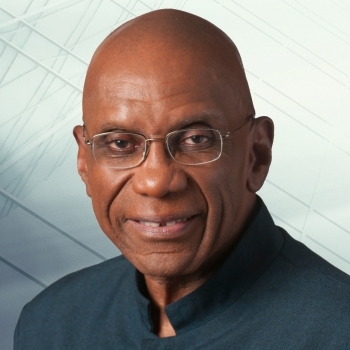
This weekly newsletter is put together by DeLisle Worrell, President of the ABCF. Visit us at Association for Barbados China Friendship | (abcf-bb.com).
Thanks to everyone who sent contributions for this week’s Update. Please send items of interest to me via the contact page at ABCF-BB.com or to info@DeLisleWorrell.com
The ABCF mission is to build a deeper understanding between the Chinese people and Barbadians and Caribbean people from all walks of life. The association’s focus is on personal experiences, people-to-people contact, cultural exchanges and exchanges of ideas, and the facilitation of travel, business and study. From the outset we aim to learn from and build on the experiences of the Caribbean and China, and to develop mutual understandings and support that will be to the benefit of both sides.