
Youth and Technology in Building Resilient Communities, from a Social Media Perspective
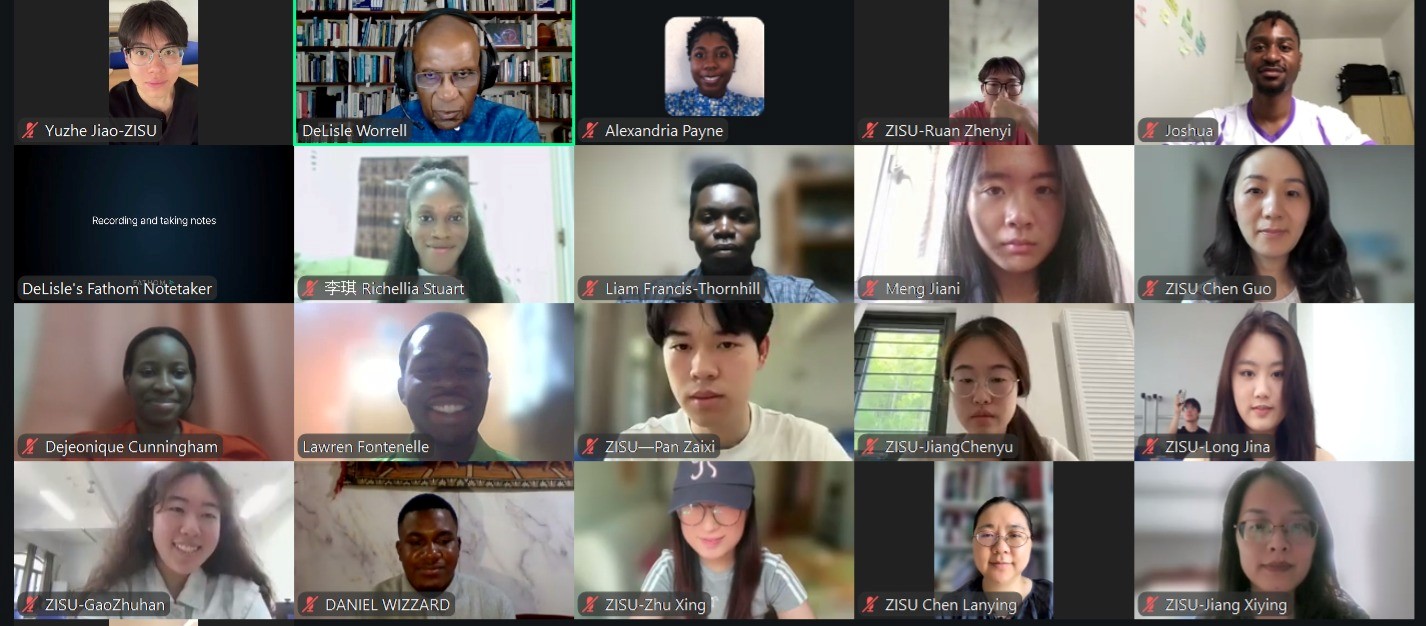
The 8th China-Barbados Youth Forum, a collaboration between the Association for Barbados-China Friendship (ABCF) and Zhejiang International Studies University (ZISU), took place by Zoom at 20:30 hours Atlantic Standard Time on Friday May 15, on the above topic.
The key messages of the forum were:
Social Media & Language Learning. Traditional language learning is limited by outdated textbooks, high costs, and lack of native-speaker practice. Social media provides free, accessible, and authentic language exposure, via gamified apps such as Duolingo (which uses streaks and leaderboards for motivation), short-Form Video such as TikTok and exchange apps such as HelloTalk and Tandem. However, there is a challenge: distinguishing between formal and colloquial speech. The use of formal guides such a language teachers and certified video creators could help.
Social Media & Health & Wellness. Social media amplifies dangerous health misinformation from unqualified sources, for example detox tea myths, vaping misinformation, skipping meals for weight loss, and unverified anxiety cures. Social media is very useful for crisis communication: information can be swiftly circulated during disasters (e.g., hurricane alerts, COVID-19 protocols). Niche, supportive online groups are created on social media for mental health and peer support. Digital health services can provide more widespread access to non-emergency consultations.
Examples of social media interventions for better health include the Barbados Ministry of Health campaigns target youth on vaping and cannabis and China’s use of Douyin (TikTok) to host professional fitness instructors and mental health advocates. The RedNote app also offers anonymous psychological consulting.
Social Media & Safety & Privacy. Balancing safety and privacy creates a fundamental trade-off. In Barbados the need for timely disaster alerts conflicts with "alert fatigue" and the spread of misinformation from crowdsourced news accounts. China's uses a "Front-end anonymous, back-end real-name" model. Accounts are linked to a verified phone number and ID card even though content creators may post under n assumed title. The goal is to enforce accountability for online speech. This enables justice for cyberbullying victims and powers life-saving tools like the Tuanyuan (Reunion) anti-trafficking app. However, there are severe privacy risks, including doxing, as personal data is centralized.
Webinar participants were urged to:
An unedited recording of the webinar may be found at this link. The webinar begins at 6:00 minutes on the recording.
AI with Calluses- Why China is Winning the Physical Robot Race
Silicon Valley is building AI to write emails. China is building AI to weld steel.
Discover the terrifying speed of "Embodied AI" and how China's drone and EV supply chains just dropped the cost of humanoid robots by 90%.
Software without physical execution is just a toy. Breaking down the geography of Embodied AI.
Why Silicon Valley's "disembodied" AI is only half the equation, and how the Chinese hardware hubs of Shenzhen and Hangzhou are using their massive factory density as the ultimate physical training data for humanoid robots.
Common Prosperity, Without Illusions
Although Beijing has made “common prosperity” one of the defining themes of China’s current political economy, and although the phrase has attracted intense attention abroad, Li Shi’s recent lecture leaves little room for optimism about the road ahead.
Beijing’s recent call to “invest in people”(投资于人)can sound, at first, like another broad policy slogan. Li Shi’s lecture gives it a much harder meaning. For him, the phrase is not a soft add-on to growth policy, but a response to the central dilemma facing common prosperity: slower growth is making it harder to expand the pie, while entrenched gaps in income, wealth, public services, and human-capital investment are making it harder to share it fairly. His lecture therefore does two things at once. It explains why “investing in people” has become necessary, and then turns the slogan into a concrete reform agenda — higher household incomes, more support for low-income families, hukou and education reform, fairer public services, and, finally, freedom.
This Is Not an Inspiring China Story
An Sanshan’s essay about his mother is heartbreaking. But the life it reveals—his mother worked to death before 50, her son still carrying cement at 66—is an indictment of generational poverty.
A 15-year-old Chinese girl who has been suffering from a severe blood disorder most of her life is slowly recovering after receiving a transplant from her newborn brother.
Xiaoyan from southern China’s Guangdong province is now only 140cm tall, and weighs just 25kg.
She was diagnosed with thalassemia, an inherited blood disorder, at three months old.
A giant orange disc recently settled into the waters off eastern China’s Shandong province, marking the deployment of what Chinese researchers describe as a first-of-its-kind intelligent ocean-observation buoy.
It abandons a mooring architecture that has dominated Western marine engineering since World War II.
Measuring six metres (19.7 feet) across, the platform has completed sea trials and officially joined the Yellow Sea observation network, enabling continuous, real-time monitoring across the entire water column, according to the Institute of Oceanology, Chinese Academy of Sciences.
A woman in eastern China shed 21.5kg in just four months because her best friend told her she would look like the famous actress Yang Mi if she became thinner.
The woman, who uses the alias taozichibubao, shared her slimming experience on social media, winning massive admiration from internet users, the Ningbo Evening News reported.
Living in Zhejiang province, the woman previously weighed 64kg. Having lost 21.5kg last year, she remained at 42.5kg for several months. She is 156cm tall, the report said.
The Confucius Institute Saturday Class
Saturday Chinese Class!!!
Primary school and Secondary school students: Free
Requirements:
Age:7+
Time: Saturdays 8:30AM—9:30AM Class 1
9:30AM—10:30AM Class 2
Interview Required.
Adults: BDS $50 for 5 Lessons
Time: Saturdays 1:00PM—2:30PM Class 1
2:30PM—4:00PM Class 2
Date: 6th June, 2026—4th July, 2026
Location: Confucius Institute, The UWI, Cave Hill Campus
Space Limited!
Payment for classes must be made at the UWI Cashiers’, located on the entry level of the Hilary McDonald Beckles Administrative Complex. The UWI Cashiers’ are opened Mondays – Fridays, 9:00 a.m. to 3:30 p.m.
To register, or for further information, please reply via email.
CONFUCIUS INSTITUTE
The University of the West Indies, Cave Hill Campus, Barbados, W.I.
Tel: (246) 629-4970 | 4971
Email: confuciusinstitute@cavehill.uwi.edu | Website: www.cavehill.uwi.edu/confucius
This weekly newsletter is put together by DeLisle Worrell, President of the ABCF. Visit us at Association for Barbados China Friendship | (abcf-bb.com).
Thanks to everyone who sent contributions for this week’s Update. Please send items of interest to me via the contact page at ABCF-BB.com or to info@DeLisleWorrell.com
The ABCF mission is to build a deeper understanding between the Chinese people and Barbadians and Caribbean people from all walks of life. The association’s focus is on personal experiences, people-to-people contact, cultural exchanges and exchanges of ideas, and the facilitation of travel, business and study. From the outset we aim to learn from and build on the experiences of the Caribbean and China, and to develop mutual understandings and support that will be to the benefit of both sides.