
7 minutes to disaster: Animation traces deadly mudslide at China-Nepal border - CGTN
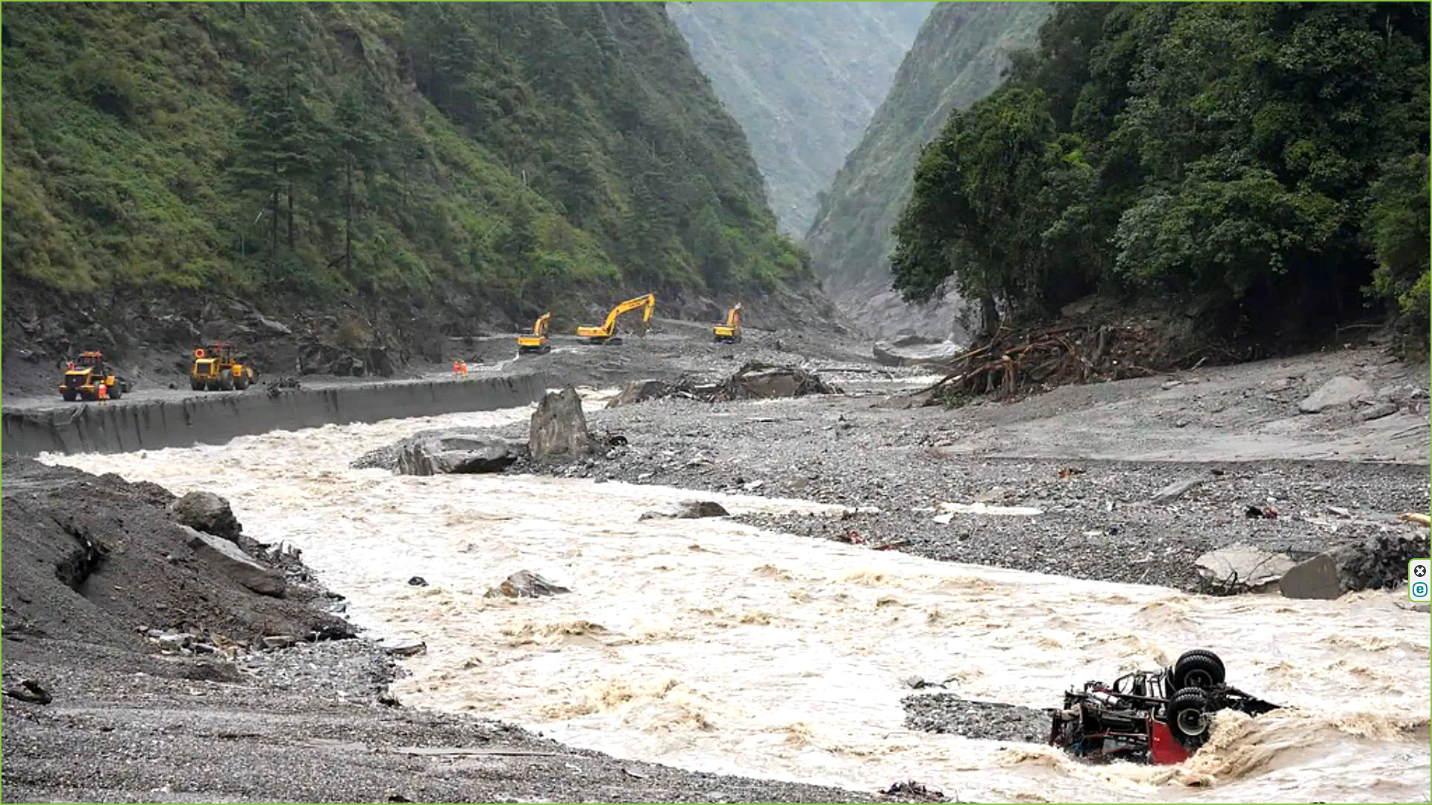
How did a glacier that broke off in Nepal smash down to Gyirong Port in China's Xizang as a wall of water, rock and debris – in just seven minutes? This animation traces the mudslide's extreme drop and trail of destruction as it swept everything in its path.
Rescue ramps up after mudslide at China-Nepal border - CGTN
Search and rescue efforts have ramped up after a powerful mudslide hit the port of Gyirong in southwest China's Xizang Autonomous Region. The first professional rescue teams reached the border crossing at around 4:30 p.m. on August 28.
Residents and tourists have been evacuated, while rescue teams continue to monitor a high-risk barrier lake that formed after the disaster.
This week’s devastating floods on the China-Nepal border could be a catalyst for joint early-warning systems, particularly in relation to a proposed rail link between the countries.
Rescuers were still struggling on Thursday to reach Gyirong Port in the Tibet autonomous region where a mudslide struck a day earlier, following flash floods from Nepal.
The port is the region’s main foreign trade gateway, which handles a third of China’s trade with its neighbour. Gyirong is also one end of a multibillion-dollar trans-Himalayan project connecting Tibet with Kathmandu.
China’s growing role in life sciences R&D | McKinsey
n this episode of Eureka!, McKinsey’s podcast on innovation in life sciences, host Alex Devereson, a senior partner in McKinsey’s London office, speaks with Fangning Zhang, a partner at McKinsey and leader in the firm’s life sciences practice in Greater China. They discuss how China has evolved from a commercial market into an increasingly important engine for pharmaceutical innovation, where AI and lab automation are already reshaping the R&D landscape, and what global pharma leaders need to do to build a genuine China strategy. An edited version of their conversation follows.
The MEA [Chinese Ministry of Exernal Affairs] has today issued a new document, outlining an 8-point consensus that has been arrived at. …
2. The two sides underlined their commitment to advancing negotiations on a framework for the settlement of the boundary question in accordance with the Agreement on Political Parameters and Guiding Principles for Settlement of the India-China Boundary Question signed in 2005 and the consensus reached in subsequent SR Talks in pursuit of a fair, reasonable and mutually acceptable solution.
3. The Expert Group on Boundary Delimitation and Working Group on Border Management under the WMCC would respectively advance discussions on an Early and Substantial Harvest of boundary delimitation and Border Management. The first task for both these groups would be to agree on their respective Terms of Reference.
4. The two sides agreed that any situation on the ground would be addressed promptly through existing diplomatic and military channels, including the WMCC, local commander‑level meetings and other agreed mechanisms, to resolve outstanding issues and avoid misunderstanding and miscalculation along the LAC. The two sides discussed ways to improve understanding of LAC in appropriate areas, for better border management….
When Local Leaders in China Pick Up the Public Hotline
What citizens’ calls reveal about everyday concerns, social change, and the role of direct intervention by local leaders
… Take western Baotou City, north China’s Inner Mongolia Autonomous Region. Since 2020, the largest category of calls to the city’s government service hotline has concerned human resources and social security, accounting for about 30 percent of the total.
Most of those callers are not filing complaints. They are asking practical questions about social insurance, employee rights, personnel files and similar matters. Social security alone accounts for roughly 85 percent of calls in this category….
Off the Beaten Track in Yichang: What’s a Tier 3 City Anyway?
…To reach Yichang from Wuhan, you must cross the Jianghan Plain, which lies directly directly west of Wuhan. It’s a massive stretch of farming flatlands - like Kansas with more rice paddies. It has been one of China's key breadbasket regions for thousands of years. In June, the fields were bursting with luxuriant green crops, dripping in the plum rains, a lush contrast to the modest grey concrete village houses squatting in small clusters across the landscape. Of course, the high-speed rail makes short work of the traverse, covering it in under an hour….
Europe’s Real Trap Is Blaming China for a Competitiveness Crisis of Its Own Making
…If European firms are losing primarily because China operates a uniquely state-supported economic system, how do we explain Europe’s performance against America?
In European eyes, the U.S. industrial system is seen as one of their own, fundamentally different from China’s. The United States’ capital allocation remains overwhelmingly market-based. Yet Europe has also fallen badly behind the U.S. in cloud computing, internet platforms, venture capital and artificial intelligence, precisely the industries meant to define its economic future.
The IMF puts it starkly: listed young American firms are worth roughly $42.9 trillion combined; their EU equivalents, about $5 trillion….
On target, upgrading, still the anchor: key messages on China's economy
… Read together, the articles make four key arguments: that the 4.7-percent growth is the number within expectations, not a disappointment; the structural upgrade behind it is genuine; major risks are being addressed deliberately; and China remains an anchor for the world economy. In addition, the fourth article details exactly how the rest of 2026 will be managed.
A Hit Chinese Legal Drama Reopens an Old Question About Lawyers
A new Chinese legal drama has prompted one of the country’s best-known law professors to reflect publicly on a question that goes to the heart of the rule of law: what happens when lawyers are punished, vilified or even prosecuted for defending people whom the public — or the authorities — already regard as guilty?
The drama, The Pillar (《重器》), has recently attracted wide attention in China. Produced by China Media Group, the country’s state broadcaster, together with the film and television centres of the Supreme People’s Procuratorate and the Supreme People’s Court — China’s highest procuratorial and judicial organs — the series revisits landmark and sometimes painful episodes in the rebuilding of China’s legal system between 1979 and 1997. Its eleven stories are adapted from real cases, including cases arising from the sweeping crime of “hooliganism” and from the 1980s “Stern Blows” campaign.
When “Flexibility” Sounds Like an Insult - by Zichen Wang
…Something similar, if vastly less dramatic, happened to Professor Zhang. Many people heard her as saying that insecure employment was itself a blessing: that workers without stable jobs, employer contributions or predictable incomes ought to appreciate the freedom bestowed upon them. Yet that is not the only plausible reading of the discussion. She was making a recognisable labour-economics point about the value workers may attach to autonomy and control over their time, while explicitly acknowledging the weaker social protection that often accompanies it. …
Her more important recent contribution has been to show how far the gig economy has escaped the smartphone screen. China’s precarious workers are often imagined as the familiar armies of food-delivery riders and Didi drivers. Professor Zhang’s research suggests something much bigger. Between 2022 and 2024 her team visited nearly 30 manufacturing firms, 20 labour intermediaries and ten labour markets in Kunshan, Dongguan, Foshan and Shenzhen. Combining fieldwork with census data, she estimated that China has roughly 40 m manufacturing gig workers, or 31.12% of the sector’s workforce. In the manufacturing clusters she studied, on-demand workers averaged around one-third of the workforce, rose to two-thirds during peak seasons, and could account for as much as 80% in some giant factories….
There is an irony in that. An economist who has spent years documenting the rise of insecure work with empathy has suddenly become famous for supposedly celebrating it. The episode is much less a verdict on one scholar than a reminder of how politically—and emotionally—loaded the vocabulary of work has become in China. When millions of people are unsure whether flexibility is something they chose or something that happened to them, even an academic distinction can strike a social nerve. The subject is tinder waiting for a spark.
Zhao Shukai: Rural Reform and the Limited Opening of Policymaking Power
China’s rural reform changed not only policy content but also how policy was made. Localities and grassroots actors gained limited room to test and shape policy, while the centre endorsed and promoted successful practices. Yet no complete, institutionalised system of decentralisation emerged, and local experiments often proceeded under ambiguous conditions. Zhao Shukai calls this a “limited opening of policymaking power,” a defining feature of Chinese politics during the reform era.
Zhao Shukai: China’s Rural Reform Had No Master Plan
Zhao Shukai argues that the decisive breakthroughs in China’s rural reform of the 1980s were not designed in advance. Household contracting and other major changes emerged through initiatives from farmers, grassroots cadres and local governments, while the central leadership was often divided over how to respond. What made these breakthroughs possible, in his account, was a relatively pluralistic political environment that gave local actors considerable room to act and allowed competing policy approaches to coexist.
Zhao draws a broader lesson from this history: good public policy cannot simply be engineered from the top. Effective policies and institutions are often discovered through competition, experimentation and decentralised initiative. The role of higher authorities, he argues, should therefore be less to prescribe solutions than to preserve the political space in which alternative solutions can emerge.
The world’s largest coal-to-liquids plant is turning coal into oil products that can power rockets and serve as machine lubricants while boosting its value sevenfold, according to a Chinese newspaper.
The production line, built by China Energy Group Ningxia Coal Industry Co Ltd, began full operations in northwest China’s Ningxia Hui autonomous region last month and processed 24 million tonnes of coal in 2025 – a quarter of the region’s total annual output, according to a report published by Science and Technology Daily on Wednesday.
The technology has been a boon this year for China, which sourced more than 40 per cent of its crude oil from the Middle East before the Strait of Hormuz was blocked.
This weekly newsletter is put together by DeLisle Worrell, President of the ABCF. Visit us at Association for Barbados China Friendship | (abcf-bb.com).
Thanks to everyone who sent contributions for this week’s Update. Please send items of interest to me via the contact page at ABCF-BB.com or to info@DeLisleWorrell.com
The ABCF mission is to build a deeper understanding between the Chinese people and Barbadians and Caribbean people from all walks of life. The association’s focus is on personal experiences, people-to-people contact, cultural exchanges and exchanges of ideas, and the facilitation of travel, business and study. From the outset we aim to learn from and build on the experiences of the Caribbean and China, and to develop mutual understandings and support that will be to the benefit of both sides.